The Man with the Robotic Arm
Tragedy can strike quickly, but recognition of the blessings that might accompany that tragedy may appear much more slowly and, to some, never.
The very nature of blessings is that they are present in all of their various forms, seen and unseen, whether or not we recognize them.
Gerard’s tragedy was an accident he had while cutting off the branches of the large oak tree behind his house. Something slipped. His left arm was cut by the chain saw, or maybe it was the falling branch. Doctors could not save his arm so he had to live without it for some time.
Gerard learned to do things differently; to rethink, reimagine what was possible for a man with only one arm. Still, despite all of his efforts to adapt he came to the conclusion that, with only one arm, he was a lesser man.
Time went by for him in this ever-present state of being less-than. Until he got the call. The doctors proposed something experimental—a robotic arm. Since anything he’d had to lose was already lost, taken away by either the saw or the branch, he said yes. His new left arm was affixed with much difficulty and acclaim, and the local newspaper announced to the world that he was now The Man With The Robotic Arm.
It took some time to get used to the idea that he might be whole again, enjoying full use of both left and right arms. Every human being seeks, expects, symmetry; so he was pleased with the appearance and the thought of symmetry—even if it meant that he was now part man, part machine.
Yet since he had been living for so long with his empty left side always deferring to the strength and competency of his right, he had to relearn many things so as not to do everything with only his right arm. He forced himself to “allow” his new robotic left arm to do a few simple tasks. Pick up his iPhone, wave at the neighbors (which they enjoyed very much, as they had never before been greeted by a robotic arm), flip the light switch, turn the steering wheel of his car. All of this was more or less a duplication of tasks he could do with his right arm.
It took a while, but eventually he realized that his new left arm could do —other things.
Not just things that it had never been able to do before, but even things that his right arm could never do. For example, his robotic left arm could lift heavy objects. Very heavy objects. Soon, Gerard had a much-beloved new party trick: lifting the front ends of cars parked in the driveway! In addition to waving at the neighbors with his robotic arm, he could also use it to lift up part of their car, amazing kids and grandparents alike. Gerard's robotic arm allowed him to become more popular in the neighborhood in a way that his original right arm, or even his original left arm, never could.
That's not all.
His new robotic arm somehow knew American Sign Language! Now Gerard could communicate silently, with such grace and distinction that his deaf associates would complement him on his grammar and style. He could converse in this way not just to communicate words; it was almost as if he was singing, and his silent form of speech took on a rather magical tone. This had a charming effect on those with whom he spoke in this way, and also had an unexpected effect on Gerard. He’d found an utterly new voice—even if only a lucky few, those who were deaf, or had made the effort to learn American sign language, this language of motion, could appreciate his new skill.
He was even more surprised that his new arm's artificial fingers could touch in a way he had never been able to touch before—he could feel things with more nuance, sense things which had previously been beyond his range.
These new abilities allowed his brain to register sensations and realities which had always been there but which, for various reasons, he’d never accessed.
He was now conscious of this new reality—a world there all along, but not previously available to him.
In these ways, he got in touch with the asymmetrical world—not as he had known it before, with one part compensating for the other, weaker part—but rather with his discovery that both of his sides were equally strong, just with different capabilities, some of which were yet to be explored. It was the asymmetry of that mystery within himself, the known and the yet to be known, which intrigued him the most. Exploration would lead him to learn entirely new ways of working, communicating, sensing. He imagined the situation was similar to when people discovered new ways to live and prosper in the world of the automobile, versus their prior dependence on horse and buggy. The calculus of distance, weight, time duration, connectivity and many other metrics evolved, even though the world around him did not change. It never does. It is we who have the opportunity to evolve, adapt, and progress beyond ourselves. The world will gladly offer us new horizons, sensed at first as novel, but as old as time itself.
I could go on about how many wonderful new things Gerard found he could do with his robotic arm; but what delighted him most was how he could play his piano once again.
He had always been pretty good, not great. It turns out that his arm (not the robotic arm, but the other one, the original right), benefited most from a little competition. Naturally, the robotic arm could play better than a jazzman in a Belle Epoch New Orleans brothel. Gerard would have been satisfied to just allow that arm to play its little heart out. He was happy to be a spectator to the talent and grandeur of his own left arm. So imagine his extreme surprise when the right arm responded on its own, matching the robot arm note for note; and then, with harmonic convergence, playing an old song in a brand new way. All on the same old piano, playing the same old song, notes exactly as before—yet somehow changed for the better, newer than new. How could this be? Gerard did not know. It made him happy. Gerard found that he had gone from less, to more.
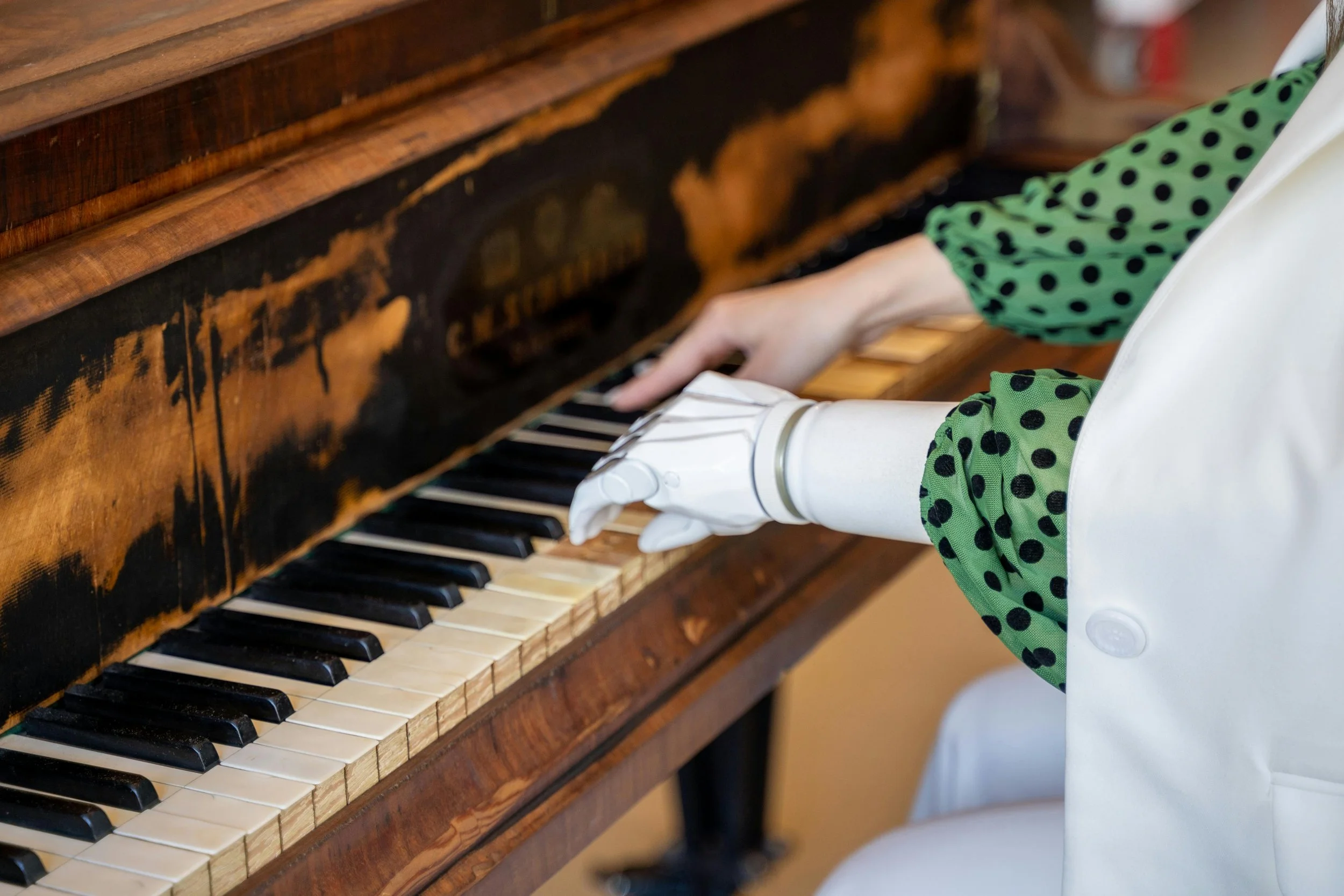
Photo by Mikhail Nilov
I am not sure that Gerard ever fully realized that this was the blessing from his tragedy. He lost his arm, and was paid back sevenfold. Now he had party tricks and neighborhood popularity, he could converse with and delight his deaf friends, even as he could talk behind the backs of his hearing friends without them ever realizing it. He could touch and feel in a way that was both minute and profound. He could see and begin to understand the realities of a world which was far bigger, more challenging and more beautiful than he had ever known. And oh, how he could play that piano! On some days, his right hand would take over the lead on a song, just like the good ol’ days when it had been the dominant hand and the left hand had deferred to its mastery. But things were so much better now. The left hand had no ego and his greatest blessing was the balance of knowing that both sides would play together, taking turns to play the lead, and that it would all be good. Better than ever before, in fact. Who could have possibly known?
Feature Image: Fistbump by Cottonbro Studio